
Every time you press the brake pedal, the pads squeeze against the rotor and that friction is what actually slows your car down. The tradeoff is that the pad material wears away a little bit with every stop. Stop and go driving around Fort Worth, Haltom City, and River Oaks chews through pads faster than cruising on the highway, because you are braking more often and usually harder. Once the pad wears down to a thin layer, the metal backing plate starts making contact with the rotor itself. That is the point where you start hearing a grinding or scraping sound, and you might feel the car pull to one side or shake when you brake. By the time it gets to that stage, you are not just replacing pads anymore, you are often looking at rotor damage too.
Signs You Need Brake Service
- Squealing or screeching when you slow down
- Grinding noise that feels like metal on metal
- Car pulls to one side when you brake
- Pedal feels soft or sinks closer to the floor
- Steering wheel shakes when you stop
- Takes longer than it used to for the car to stop
Before we touch a single part, we pull the wheels off and get eyes on the actual pad thickness, the condition of the rotor surface, and the hardware sitting behind it all. We are checking for uneven wear across the pad, which can mean something more than normal use is going on, like a sticking caliper or an alignment problem pulling the car to one side under braking. We also check brake fluid condition, since old or contaminated fluid can affect how the whole system performs, and we look for any leaks in the lines running to each wheel. There is no point swapping in new pads if the real issue is a caliper that is not releasing properly or a line that is slowly leaking fluid.
A standard brake job starts with removing the wheel to get full access to the brake assembly. From there we pull the caliper, swap out the old pads for new ones, and take a close look at the rotor to decide if it can be resurfaced or needs replacing. If the rotor thickness has worn past a safe point, or if it has warped enough to cause pulsing in the pedal, we replace it instead of trying to resurface something that is already too thin. We also clean up the caliper slides, since dirty or sticky slides keep the pads from sitting flush against the rotor and can cause uneven wear down the road. If the fluid was low or looked contaminated during the inspection, we bleed the brakes to get fresh fluid through the lines. The last step before we hand the car back is a test drive, checking that the pedal feels firm and the car stops straight without pulling.


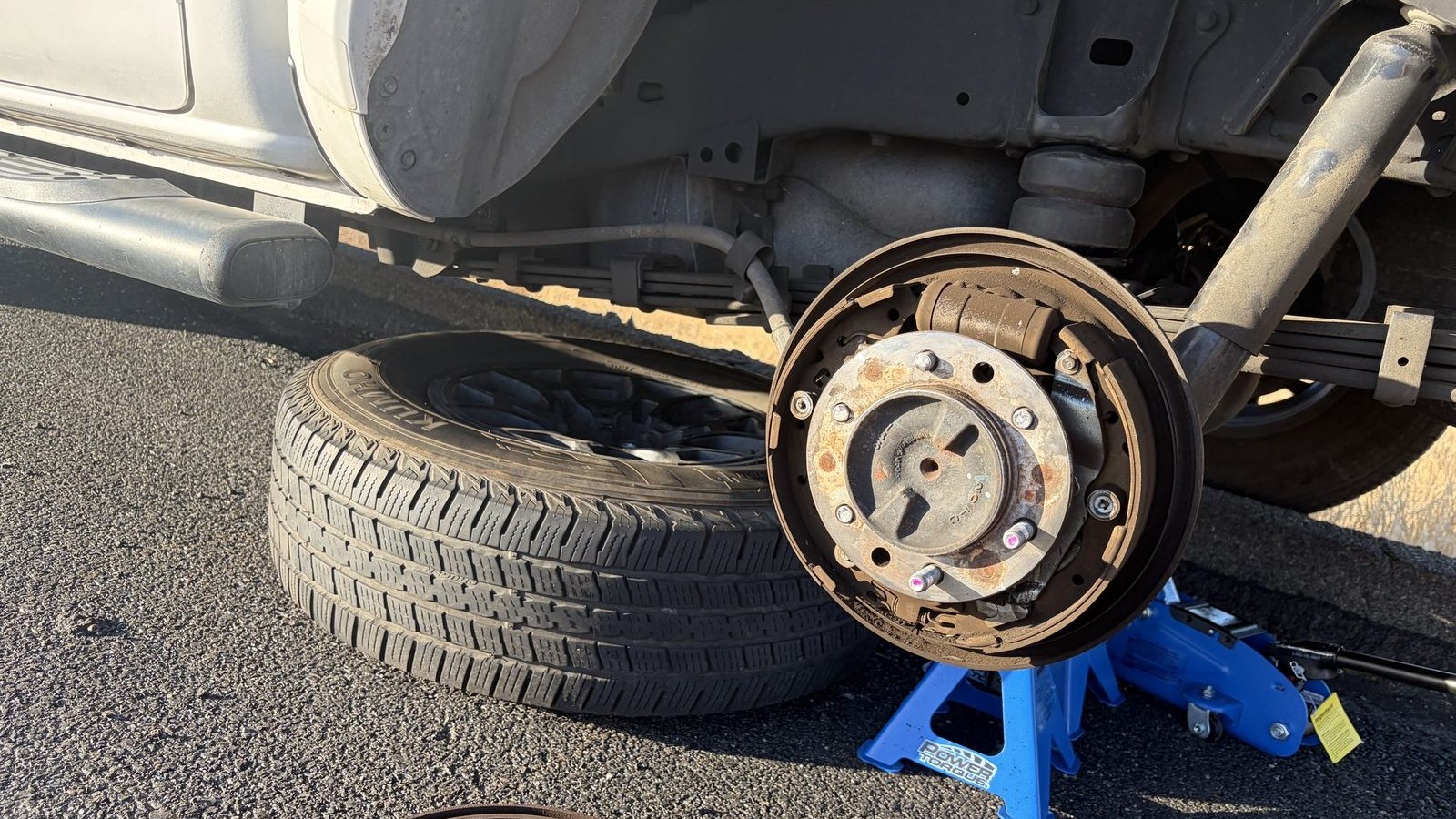
Not every brake job stays simple. A seized caliper that will not release properly adds extra time and parts to the repair, since the whole caliper usually needs replacing rather than just the pads. A leaking brake line is another thing that changes the scope of the job, because that is a safety issue on its own and has to get fixed before the car is safe to drive. Rotors that are too far gone to resurface mean a full rotor replacement instead of a quick resurface and reuse. Rear brakes bring their own complication too, since many cars route the parking brake mechanism through the rear brake assembly, which adds extra steps to the job. On top of all that, how many wheels actually need work changes the scope, since front and rear brakes often wear at very different rates depending on the car and how it is driven.
Front and rear brakes rarely wear evenly. Most cars put more braking force on the front wheels, since weight shifts forward every time you slow down, so front pads usually wear out faster than the rears. That means a lot of cars only need front brake work for a while before the rears ever need attention. But some vehicles, especially ones with a rear-heavy brake bias or certain truck and SUV setups, wear the rear pads down just as fast or faster. That is part of why we check all four corners during inspection instead of assuming the wear pattern based on mileage alone. Uneven wear between wheels is also a clue that something besides normal use is going on, like a caliper not releasing fully or a brake hose restricting fluid flow on one side only.
Grinding noise and a soft or spongy pedal are two of the clearest warning signs that something needs attention. Grinding usually means the pad material is gone and metal is now contacting metal, which means rotor damage is likely already happening. A soft brake pedal can point to air in the lines, a fluid leak, or worn components that are not engaging the way they should. If you notice either of these, it helps to avoid hard stops and highway driving until the car gets checked, since those are the situations that put the most stress on an already weakened brake system. Easing into stops and taking it slower in traffic can buy you a little time, but it does not fix the underlying problem.
Some brake symptoms are a lot more serious and should not wait at all. If the pedal sinks toward the floor when you press it, or if the car pulls hard to one side under braking, that points to a real failure somewhere in the system, not just normal wear. A sinking pedal often means a fluid leak or a failing component that is letting air into the lines, and a hard pull to one side can mean a caliper has seized or a brake line is restricted on one wheel. Either of those situations affects how the car stops in an emergency. Grinding, pulling, and a soft or sinking pedal all point to problems serious enough that the car should get looked at before doing much more driving, especially around Lake Worth, Blue Mound, or anywhere with regular stop and go traffic.
What to Tell Us When You Call
- Year, make, and model of your car
- What you are hearing or feeling, like grinding or a soft pedal
- Which wheels seem worse, front or rear
- Where the car is located so we can come to you

 Supercanic