
Your suspension is the shocks, struts, springs, and control arms that soak up bumps so the car stays level and the tires stay on the ground. Steering is the rack, tie rods, and linkage that turn the wheels when you move the steering wheel. These two systems work together. If one is off, the other has to compensate, and that shows up as a car that feels loose, wanders, or pulls. Both take a beating from Fort Worth potholes, curb hits, and plain old age. Rubber bushings dry out and crack from heat and sun. Shocks lose their fluid and stop damping, so the car bounces more than it should after a bump. Tie rod ends wear loose over time. Once one part goes bad, the rest start wearing faster because the geometry of the whole system is off and every part downstream has to work harder than it was built for.
Signs You Need Suspension or Steering Work
- Car bounces a few times after hitting a bump instead of settling right away
- Steering wheel shakes at highway speed
- Clunking noise over bumps or potholes
- Car pulls to one side when you let go of the wheel a little
- Tires wearing unevenly on the edges or in patches
- Steering feels loose or you have to turn the wheel more than usual to get a response
Before we replace anything we put the car on a lift and check it by hand, because looking at it from the ground does not tell you much. We grab the tires top and bottom and side to side to feel for play in the wheel bearings and tie rods. Any looseness there means something is worn past where it should be. We look at the shocks and struts for leaking fluid, since a wet strut body is a sign it has lost its damping ability. We check the bushings for cracks and the ball joints for looseness, both common failure points on older suspensions. We also look at tire wear patterns, since uneven wear on the inside or outside edge tells us a lot about what is going bad before we even touch a wrench. We only replace what is actually worn, not a whole list of parts just in case.
The job depends entirely on what is worn and where it sits in the system. A tie rod or sway bar link replacement is a fairly straightforward swap, since those parts bolt in and out without much else involved. Struts or shocks come out, the new ones go in, and the car usually needs an alignment after since ride height and angles shift slightly with new parts. Control arm work takes more time since there are multiple bolts holding it in place and sometimes rusted hardware that fights back the whole way. After any suspension or steering work, we check the alignment and road test the car to make sure it tracks straight, holds its lane without correction, and the steering feels right in your hands instead of vague or heavy.


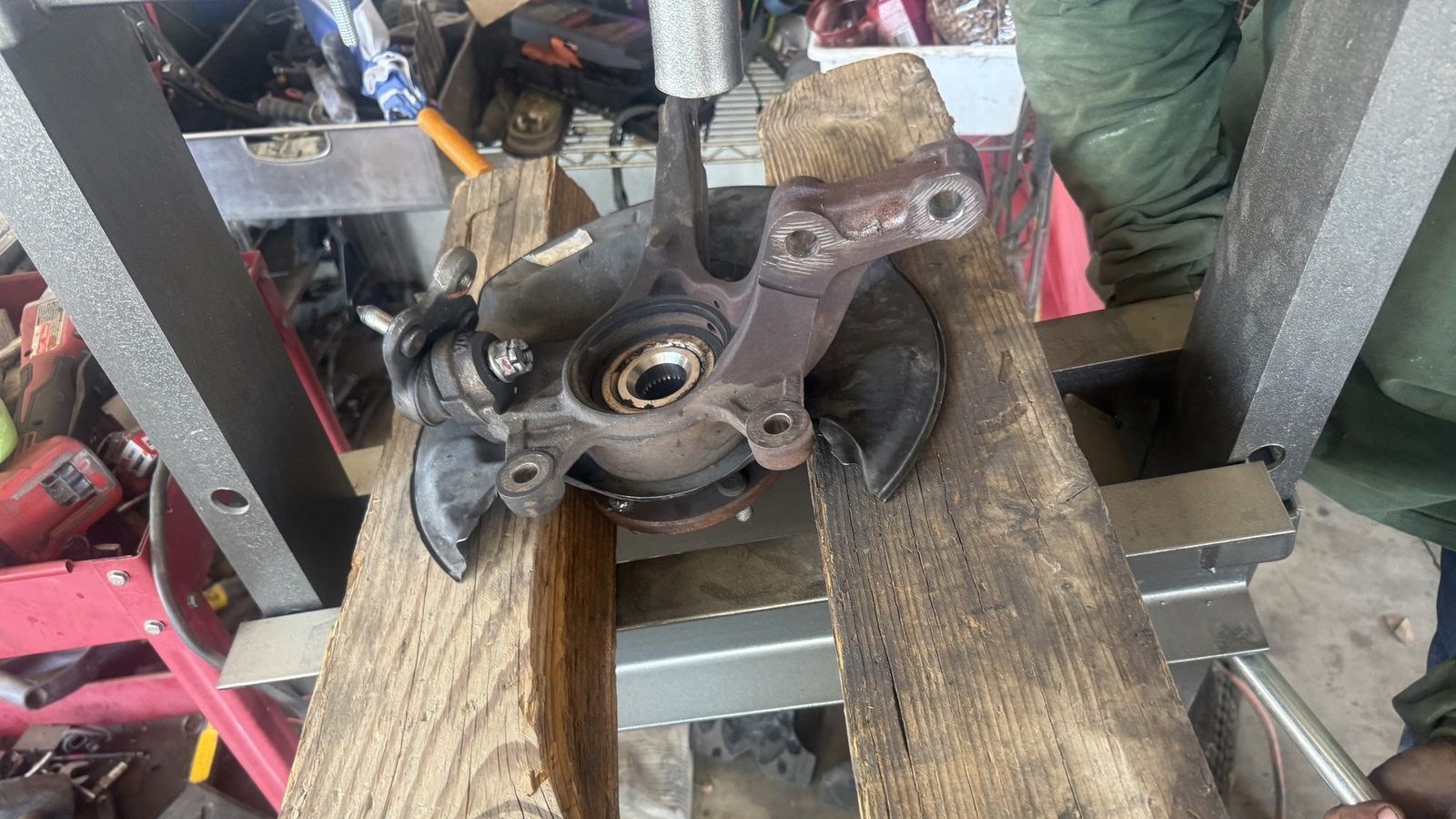
What changes the size of the job is mostly how many parts are worn and how rusted the bolts holding them in have become. A car that has had one problem ignored for a while often has two or three parts that wore out together, since a bad bushing or worn joint puts extra stress on its neighbors. Rusted bolts from humidity and road exposure can take longer to break loose than the actual repair itself, especially on control arm mounts and strut hardware that rarely gets touched. Alignment is almost always part of the job once suspension parts are swapped, since new parts change the angles the old worn ones had settled into over years of driving. Skipping the alignment after a repair means the new parts wear unevenly too, which defeats the purpose of replacing them in the first place.
A steering wheel that shakes at speed is often a sign of a worn tie rod, a bad wheel bearing, or a tire that is out of balance from uneven wear. A car that pulls hard to one side without you steering it there usually points to alignment being off or a control arm or ball joint that has given up. Either symptom means the car is not tracking the way it was built to, and that affects more than comfort. It changes how the car responds when you need it to respond fast, like swerving around something in the road. These are not symptoms to wait out or guess at, since they tend to get worse gradually until one day they get worse fast.
Worn suspension and steering parts affect how the car handles in an emergency stop or a quick swerve, which is exactly when you need the car to do what you expect it to do. A loose tie rod or a blown shock changes how much the tires stay planted during hard braking or a sudden lane change. That is the kind of failure you do not want to discover for the first time in traffic. If your steering wheel is shaking or the car is pulling hard to one side, do not keep driving on it like normal and hope it settles down on its own, because it usually does not. Keep speeds down, avoid rough roads if you can, and get it looked at before it gets worse or damages a tire from the uneven wear that follows.
We work on cars throughout Fort Worth and nearby areas including River Oaks, Sansom Park, Westover Hills, Westworth Village, Blue Mound, Haltom City, and Lake Worth. Suspension and steering problems do not wait for a convenient day, and they tend to compound the longer they sit, turning a simple tie rod swap into a job with three or four worn parts involved. If your car feels different on the road than it used to, whether that is a shimmy at highway speed, a clunk over bumps, or a pull to one side, it is worth having someone put it on a lift and check it by hand rather than guessing from the driver's seat. Call us at 817-983-5777 to talk through what you are feeling in the car and get it looked at properly.
What to Tell Us When You Call
- Year, make, and model of the car
- What you hear or feel, like clunking, shaking, or pulling
- When it happens, like over bumps, at highway speed, or turning
- Any recent curb hits, pothole strikes, or new tires

 Supercanic